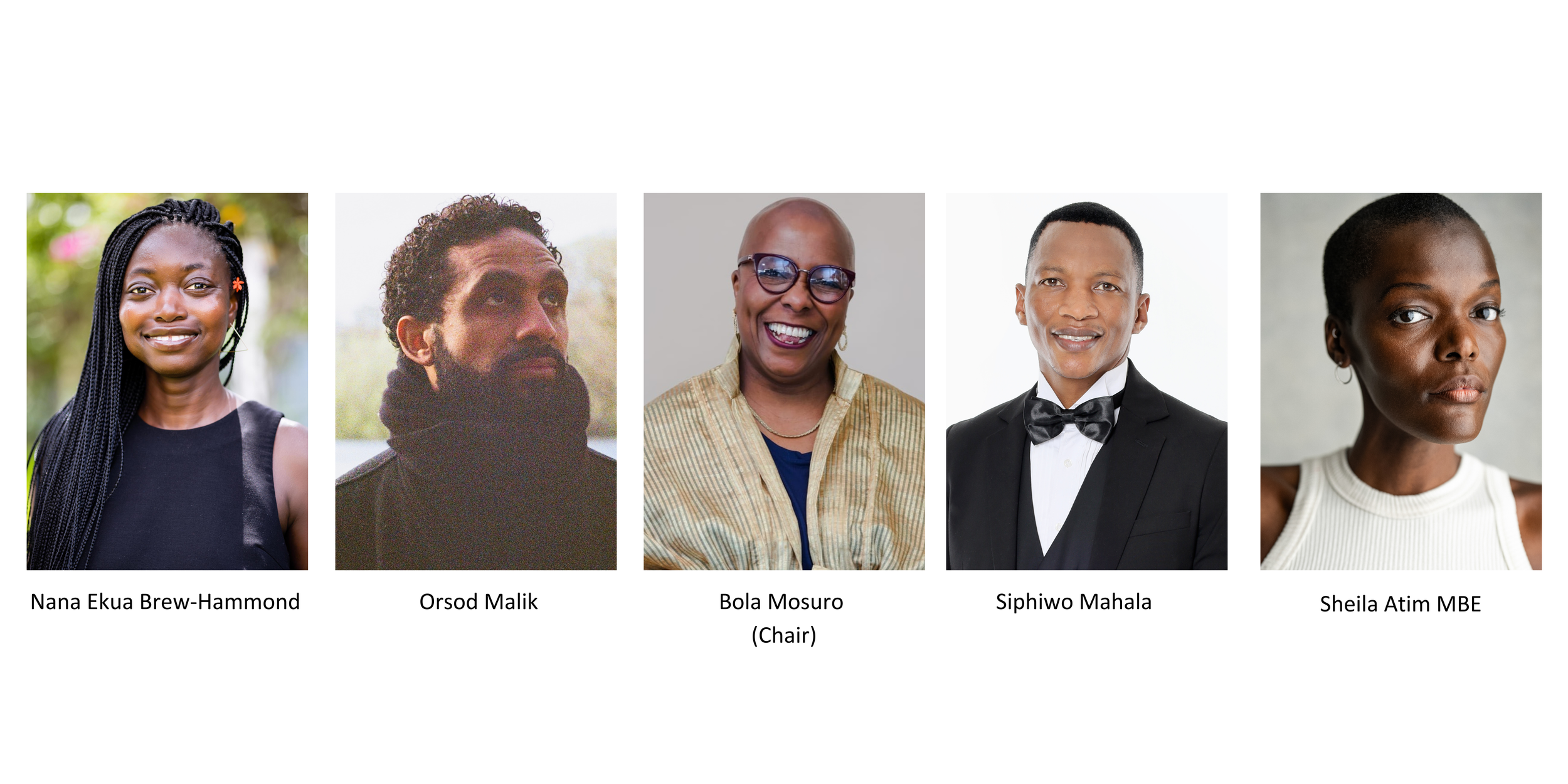
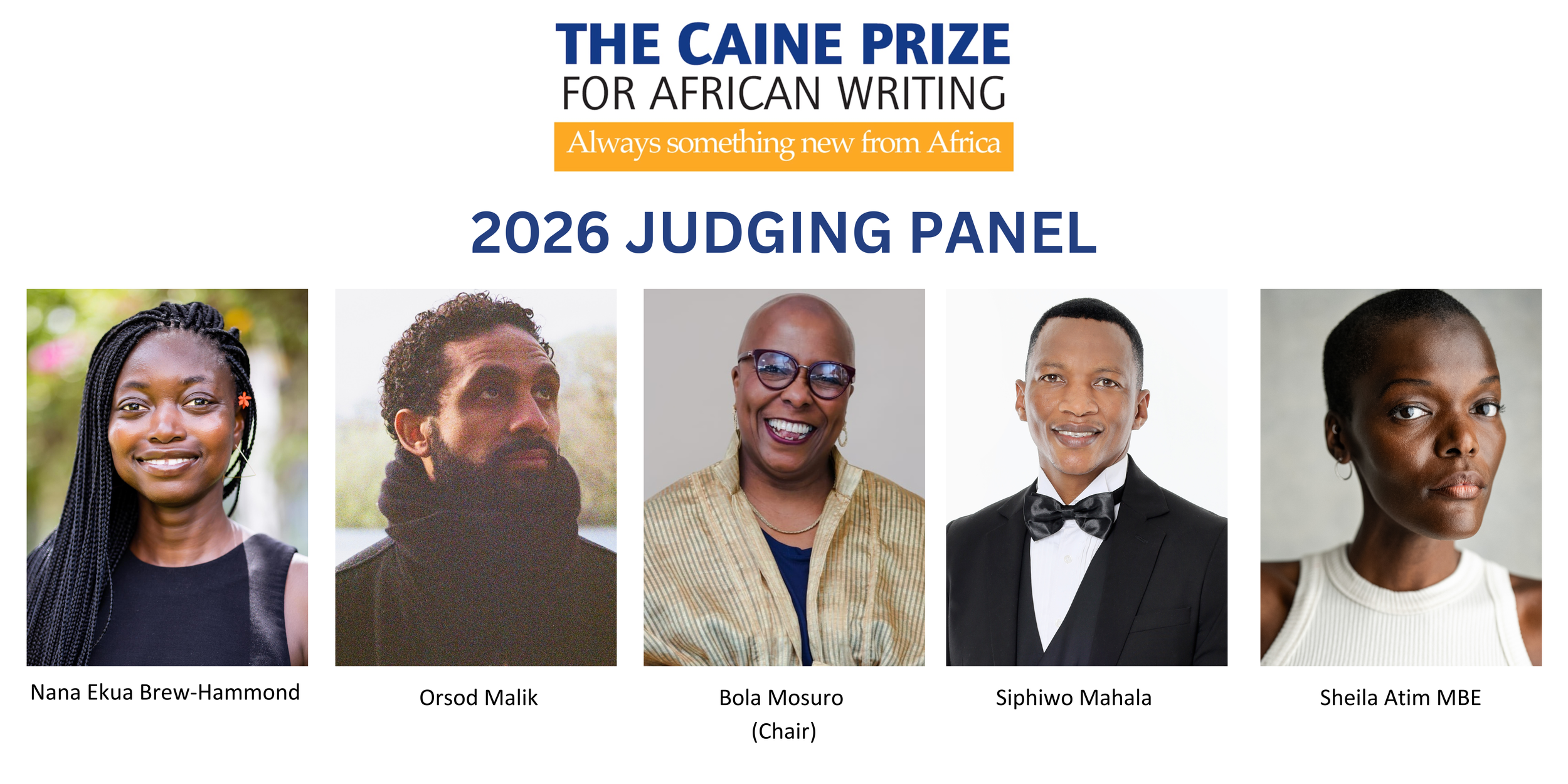
[London, UK] – The Caine Prize for African Writing has announced its 2026 panel of judges. This year’s panel assembles a formidable mix of talent, insight and expertise spanning arts and culture at the highest level. Together, they reflect the Prize’s commitment to platforming rich and varied narratives. Joining Chair of Judges Bola Mosuro (announced last week), are Nana Ekua Brew-Hammond, Orsod Malik, Siphiwo Mahala and Sheila Atim MBE.
Commenting on this year’s panel, Ellah Wakatama OBE (Hon) FRSL, Chair of the Prize said: “Over the years, we have been intentional about challenging the idea that there is such a thing as a ‘Caine Prize story’ and, by extension, an ‘African story.’ One of the ways we have achieved this is by assembling panels of cultural producers drawn from different disciplines, geographies, generations, and lived experiences, united by one purpose – valorising the best short stories being written today. The result is a shortlist that resists expectation and reflects, as one of our judges Siphiwo Mahala so beautifully put, a ‘kaleidoscope of contemporary African voices.’”
“As publishers continue to submit work, we invite them to let go of inherited assumptions about what an ‘ideal’ story looks like. We champion boldness – of form, perspective, genre, and themes – and we urge writers to push beyond the familiar edges of their practice. Bola, Nana, Orsod, Siphiwo, and Sheila are unequivocally aligned in this belief, and they are eagerly waiting for your submissions and the stories that will surprise us all.”
With entries to the Prize closing at midnight on 27 February 2026, the five shortlisted stories and their authors will be announced on 1 September 2026.
This year’s Chair of Judges is Nigerian journalist, broadcaster, and documentary maker, Bola Mosuro. Mosuro started her career in the African development sector, working for the NGO Institute of African Alternatives and as a board member for Akina Mama Wa Afrika. For over three decades, Mosuro was a familiar voice for BBC World Service listeners, presenting on Network Africa, Focus on Africa and Newsday. She’s produced various programmes and documentaries including ‘The Story of Africa’, a radio history series for the BBC. More recently, she appears as presenter of the Loftus Media documentary, ‘Shepherd’s Eye in the Sky’ produced for the BBC World Service (forthcoming, 31 January 2026), in which she speaks with pastoralists across East and West Africa about climate solutions. As a narrator, Mosuro is the host of ODI/SPARC podcast series ‘Dynamic Drylands’ focusing on the nomadic peoples and rangelands of Africa. This year sees the launch of her own podcast, ‘Breaking Bread with Bola.’
Mosuro is joined on the panel by Nana Ekua Brew-Hammond, a Ghanaian-American author and editor of fiction, non-fiction, and poetry for children, teens, and adults. Her works for young people include the Young Adult novel Powder Necklace and the children's picture book Blue: A History of the Color as Deep as the Sea and as Wide as the Sky. For adults, she edited Relations: An Anthology of African and Diaspora Voices and wrote My Parents’ Marriage: A Novel. Learn more at nanabrewhammond.com;
Orsod Malik, a Sudani curator of exhibitions and archives, writer, independent researcher, and the Executive Director of the Stuart Hall Foundation. He currently serves as a Trustee at The Common Guild, a visual arts organisation in Glasgow. Malik’s work explores transnational cultural and political entanglements in historical narratives to consider the possibility of shared histories. He is particularly interested in the relationship between social movements, aesthetics, and public education, and their combined role in shaping collective identities. Malik has curated exhibitions and developed programmes for several cultural organisations including, the Stuart Hall Foundation, International Curators Forum (ICF), Black Cultural Archives, Institute of International Visual Arts (iniva), Prince Claus Fund and the British Council;
Siphiwo Mahala, a multi-award-winning South African writer and academic, plying his trade in English and isiXhosa. He is a graduate of the University of Fort Hare, holds a Master’s degree in African Literature from Wits University and a PhD in English Literature from the University of South Africa. He is the author of the novel, When a Man Cries (2007), which he later translated into isiXhosa as Yakhal’ Indoda (2010). His short story collections include African Delights (2011), Red Apple Dreams and Other Stories (2019), and The Missing Pages (2025). He wrote two critically acclaimed plays, The House of Truth (2016) and Bloke and His American Bantu (2021). His monograph Can Themba: The Making and Breaking of the Intellectual Tsotsi (2022) won the Creative Non-Fiction Award at the South Africa Literary Awards in 2023 and the 2024 Book of the Year at the Vice-Chancellor’s Distinguished Awards. For two years, he served as the Chair of Judges for the fiction panel of the Sunday Times Literary Awards. He is an Associate Professor in the English Department at the University of Johannesburg;
Sheila Atim MBE, a Ugandan-British actress, singer, composer, and playwright. Film credits include The Woman King (Sony) - earning a BAFTA Rising Star nomination and the Chopard Trophy at Cannes - Doctor Strange & the Multiverse of Madness (Marvel), Mufasa and Pinocchio (Disney), Bruised (TIFF Rising Star Award), Dust Bunny (Thunder Road Pictures), and All Dirt Roads Taste of Salt (A24). Television work includes the upcoming Blade Runner 2099 (Amazon/Alcon), The Underground Railroad (Amazon), The Irregulars (Netflix), Harlots (Hulu), and The Pale Horse (BBC/Amazon). On stage, Sheila has appeared in a Shakespeare trilogy at the Donmar Warehouse, Othello at Shakespeare’s Globe, and Constellations at the Donmar, winning the 2022 Olivier Award for Best Actress. She also starred in Girl From the North Country (Old Vic/Noël Coward), earning the 2018 Olivier Award for Best Supporting Actress in a Musical alongside multiple major nominations. In addition to acting, Sheila is a composer and a writer, with several film and television projects in development. She holds an MBE for services to drama.
The judges will meet in September to select and announce a winner from the five shortlisted authors.
Each writer shortlisted for the Caine Prize will be awarded £500, and the winner will receive a £10,000 prize. If a work in translation is chosen as the winning story, the prize will be split 70% to the author and 30% to the translator.
The five shortlisted stories will be compiled into the official Caine Prize anthology and published alongside stories from the live workshop to be held this spring.
-Ends
Media Contact: comms@caineprize.com
Press Package: Access via Dropbox here
About The Caine Prize for African Writing
The Caine Prize for African Writing is an annual award for African creative writing. The Prize is awarded for a short story by an African writer published in English (indicative length 3,000 to 10,000 words). The Caine Prize for African Writing is named after the late Sir Michael Caine, former Chairman of Booker plc and Chairman of the Booker Prize management committee for nearly 25 years. The African winners of the Nobel Prize for Literature, Wole Soyinka and J M Coetzee, are Patrons of The Caine Prize. Ellah Wakatama OBE (Hon) FRSL is the Chair.
An African writer is taken to mean someone who was born in Africa, or who is a national of an African country, or who has a parent who is African by birth or nationality. Works translated into English from other languages are not excluded, provided they have been published in translation, and should such a work win, a proportion of the prize would be awarded to the translator.
Previous winners are Sudan’s Leila Aboulela (2000), Nigerian, Helon Habila (2001), Kenyan, Binyavanga Wainaina (2002), Kenyan, Yvonne Owuor (2003), Zimbabwean, Brian Chikwava (2004), Nigerian, Segun Afolabi (2005), South African, Mary Watson (2006), Ugandan, Monica Arac de Nyeko (2007), South African, Henrietta Rose-Innes (2008), Nigerian, EC Osondu (2009), Sierra Leonean, Olufemi Terry (2010), Zimbabwean, NoViolet Bulawayo (2011), Nigerian, Rotimi Babatunde (2012), Nigerian, Tope Folarin (2013), Kenyan, Okwiri Oduor (2014), Zambian, Namwali Serpell (2015), South African, Lidudumalingani (2016), Sudanese writer, Bushra al-Fadil (2017), Kenyan, Makena Onjerika (2018), Nigerian, Lesley Nneka Arimah (2019), Nigerian-British, Irenosen Okojie (2020), Ethiopian, Meron Hadero (2021), Kenyan, Idza Luhumyo (2022), Senegalese, Mame Bougouma Diene and Woppa Diallo (2023), and South African, Nadia Davids (2024).